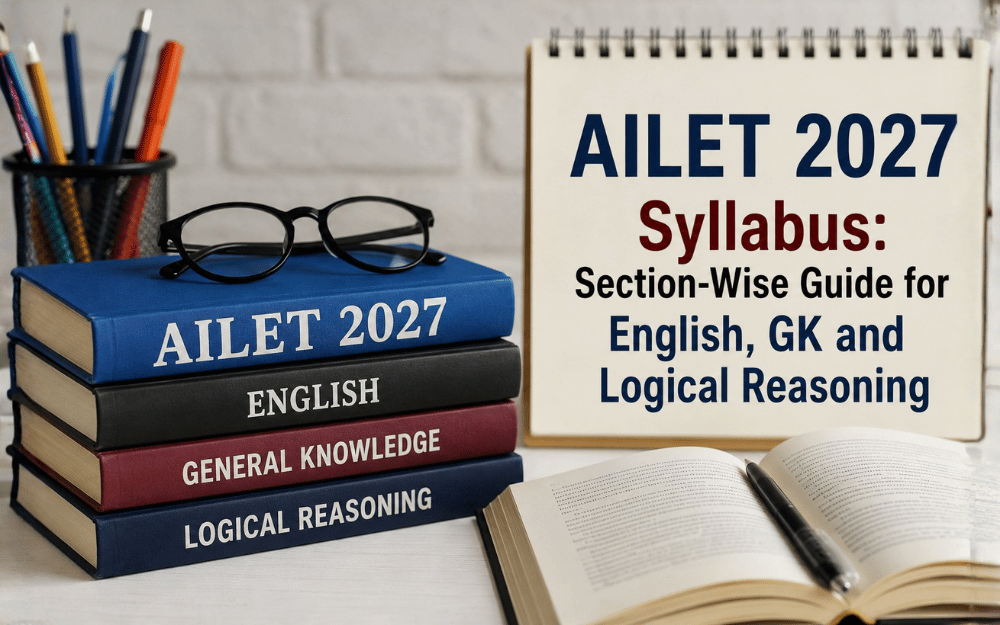
Most students preparing for AILET 2027 make the same mistake early on. They start practising without fully understanding what the syllabus actually demands from each section.
The AILET 2027 syllabus is not complicated. It has three sections. But each section tests a different kind of thinking, rewards different preparation habits and punishes different mistakes. If you treat all three sections the same way, you will underperform in at least one of them on exam day.
This guide breaks the AILET syllabus down section by section, explains what each part actually tests, lists the important topics, and tells you how to prepare for each one practically. By the end, you will know exactly where to spend your time and how to build a preparation plan that works across all three sections.
If you are also preparing for CLAT 2027 alongside AILET, this guide connects the syllabus differences between the two exams so you can plan both together without confusion. You can read the full CLAT 2027 guide for a complete picture of what CLAT demands separately.
AILET 2027 Syllabus Overview: The Big Picture First
Before going section by section, it helps to see the full AILET 2027 syllabus structure in one place.
| Section | Number of Questions | Total Marks | Weightage |
| English Language | 50 | 50 | 33% |
| Current Affairs and GK | 30 | 30 | 20% |
| Logical Reasoning | 70 | 70 | 47% |
| Total | 150 | 150 | 100% |
Three things stand out immediately from this table.
- Logical Reasoning is not just another section in AILET. With 70 out of 150 marks, it is almost half the paper. Students who go into AILET without preparing this section seriously are essentially conceding half the exam before they begin.
- The English Language carries 50 marks, which is more than any single section in CLAT. AILET English is heavier, more vocabulary-driven and less forgiving than CLAT English.
- Current Affairs and GK has the lowest weightage at 20 per cent, but it is also the most predictable section. Students who prepare it consistently gain reliable marks without surprises on exam day.
The AILET marking scheme is plus one for every correct answer and minus 0.25 for every wrong answer. Unattempted questions carry no penalty. At the top of the AILET rank list, accuracy matters far more than the number of attempts.
AILET 2027 English Language Syllabus: What It Actually Tests
Most students who have prepared for CLAT 2027 feel comfortable going into AILET English. That confidence is partly justified but partly dangerous. AILET English is similar to CLAT English in some ways and significantly harder in others.
The biggest difference is vocabulary. AILET English tests vocabulary depth in a way that CLAT does not. You will encounter antonyms, synonyms, idioms and contextual word usage questions that require a stronger word bank than CLAT passage-based reading demands.
Topics covered in the AILET 2027 English Language syllabus
- Reading comprehension passages with inference, tone and main idea questions
- Fill in the blanks with appropriate words or phrases
- Antonyms and synonyms
- Idioms and phrases
- Jumbled words and sentences
- Choosing the correct word to complete a sentence
- Error identification in sentences
- Para-completion and sentence improvement
What AILET English actually rewards
Reading comprehension in AILET tests your ability to understand what is directly stated, what is implied and what the author’s tone and purpose are. These are similar to CLAT comprehension questions, but the passages in AILET can be denser and the vocabulary questions that follow demand active recall rather than contextual guessing.
Grammar questions in AILET are more direct than CLAT. Where CLAT tests grammar through passages and inference, AILET can ask standalone grammar questions covering subject-verb agreement, tense usage and sentence correction.
The honest assessment:
A student with strong daily reading habits and a consistent vocabulary practice routine will find AILET English manageable. A student who has only done passage-based CLAT comprehension practice without building vocabulary will struggle with the direct vocabulary questions in AILET.
How to prepare for AILET English
Read one quality national newspaper every day without skipping. The Hindu and the Indian Express both work well. Do not just read. Make a habit of noting unfamiliar words, looking them up and revisiting them the next day. This one habit built over four to five months creates a vocabulary base that handles both CLAT and AILET English comfortably.
For vocabulary specifically, Word Power Made Easy by Norman Lewis is the most widely used and most practical resource for AILET aspirants. Work through it systematically rather than randomly.
For comprehension, use the previous year’s AILET question papers. They show you the exact passage length, question style and difficulty level you will face. No practice material matches actual past papers for this purpose.
NPLC’s online CLAT and AILET coaching covers English preparation with a focus on building reading speed and vocabulary depth simultaneously, so students do not have to treat the two exams as separate preparation tracks.
AILET 2027 Current Affairs and GK Syllabus: The Most Scoring Section
Here is something most AILET coaching guides do not say directly enough: Current Affairs and GK is the most scoring section in AILET relative to the effort required.
Logical Reasoning carries more marks, but it demands deeper daily practice and takes longer to improve. English requires sustained reading habits over months. GK, when prepared consistently with a clear structure, gives you reliable marks without the same depth of skill-building required in other sections.
The keyword is consistently. Students who revise current affairs every month from the start of their preparation build a strong, layered knowledge base. Students who try to cover months of current affairs in the final few weeks before the exam will find the task overwhelming and their recall shallow.
Topics covered in the AILET 2027 Current Affairs and GK syllabus
Static GK Topics:
- History of India and the world
- Indian and world geography
- Indian polity and constitution
- Economics and economic development
- General science, including physics, chemistry and biology basics
- Environmental science and ecology
Current Affairs Topics:
- National and international events from the past 12 to 18 months
- Supreme Court judgments and legal developments
- Government schemes and policies
- Science and technology updates
- Sports, awards and appointments
- Important summits, treaties and agreements
- Economic developments and budget highlights
How AILET GK differs from CLAT GK
This is one of the most important differences students need to understand when preparing for both exams together. In CLAT 2027, all current affairs questions are passage-based. You read a news passage and answer questions based on what is written. Direct factual recall is rarely tested in CLAT.
AILET is different. Current Affairs and GK questions in AILET can be direct factual questions. You either know the answer or you do not. This means a pure reading habit is not enough for AILET GK. You need active recall through regular revision.
If you are preparing for both CLAT and AILET together, your GK preparation strategy needs to cover both angles. Daily reading for CLAT passage comprehension plus regular active recall revision for AILET direct questions. It is the same content, but two different preparation modes working together.
How to prepare for AILET GK
Follow current affairs daily from August 2026 onwards. Focus on legal developments, Supreme Court judgments, constitutional amendments and policy changes because these appear most frequently in AILET.
For static GK, NCERT textbooks from Class 9 to 11 cover the history, geography, polity and science topics that AILET tests. You do not need to go beyond this level for static GK.
NPLC’s free monthly current affairs magazine is structured specifically to cover the topics that appear in both CLAT and AILET every year. Instead of collecting news from multiple scattered sources, students get a structured monthly revision resource that covers both exams in one place. You can access it through NPLC’s resources page.
The approach that works: cover current affairs month by month from the start of your preparation, revise each month before moving to the next, and keep short notes of the most important developments for quick revision in the final two weeks before the exam.
AILET 2027 Logical Reasoning Syllabus: Where the Exam Is Won or Lost
If you understand only one thing about the AILET 2027 syllabus, make it this: Logical Reasoning decides your rank.
With 70 questions worth 70 marks, Logical Reasoning accounts for nearly half the entire paper. In CLAT 2027, Logical Reasoning has 22 to 26 questions. In AILET, it has 70. The scale of difference is not small. It is the defining structural difference between the two exams.
Students who come from strong CLAT preparation backgrounds often find that their CLAT Logical Reasoning preparation is useful but not sufficient for AILET. AILET Logical Reasoning is more direct, more varied and demands faster processing than the passage-based reasoning questions in CLAT.
Topics covered in the AILET 2027 Logical Reasoning syllabus
Argument-based reasoning:
- Identifying arguments and their components
- Strengthening and weakening arguments
- Evaluating assumptions behind a statement
- Drawing valid conclusions from given premises
- Identifying logical flaws and fallacies
Analytical reasoning:
- Syllogisms and deductive reasoning
- Statement and assumption questions
- Statement and conclusion questions
- Cause and effect reasoning
- Logical sequences and series
Legal reasoning within Logical Reasoning:
- Legal propositions applied to fact situations
- Legal maxims and their applications
- Principle-based reasoning using passages
- Important legal concepts tested through logical scenarios
Puzzle-based reasoning:
- Seating arrangements
- Blood relations
- Direction-based problems
- Coding and decoding
- Ranking and ordering
An important clarification on Legal Reasoning in AILET
NLU Delhi confirmed that AILET does not require prior legal knowledge. Any legal principles or concepts needed to answer a question are provided within the question itself. This is the same approach as CLAT Legal Reasoning, where the passage gives you the principle and you apply it to a fact situation.
What AILET adds beyond CLAT is the sheer volume. Seventy reasoning questions in 120 minutes alongside English and GK means your average time per question across the whole paper is 48 seconds. For Logical Reasoning specifically, maintaining speed without sacrificing accuracy is the core challenge.
How AILET Logical Reasoning differs from CLAT Logical Reasoning
| Factor | CLAT Logical Reasoning | AILET Logical Reasoning |
| Number of questions | 22 to 26 | 70 |
| Format | Fully passage-based | Mix of passage and direct questions |
| Question types | Arguments, conclusions, inferences | Arguments, syllogisms, puzzles, legal principles |
| Difficulty | Moderate | Higher, more varied |
| Time pressure | Manageable | Significant |
The core skill overlap is real. A student who is strong in CLAT Logical Reasoning has a solid foundation for AILET. The adjustment needed is volume practice and exposure to AILET-specific question types like syllogisms and puzzles, which do not appear in CLAT.
How to prepare for AILET Logical Reasoning
Daily practice is the only approach that works here. Understanding logical reasoning concepts without daily question practice does not translate into exam performance. The skill of working through reasoning problems quickly and accurately is built through repetition, not through reading about reasoning.
Start with foundational question types: assumptions, inferences, arguments and conclusions. These form the majority of AILET Logical Reasoning questions and they are the same types that appear in CLAT, which means dual preparation here genuinely works.
Add syllogisms and puzzle-based questions specifically for AILET. RS Aggarwal’s Verbal and Non-Verbal Reasoning is useful for building foundational skills in these areas. Use it to build a base and then shift entirely to the actual AILET previous year questions.
The most powerful preparation habit for AILET Logical Reasoning is taking full-length AILET mock tests under timed conditions and then spending at least as much time analysing wrong answers as you spent taking the test. Understanding why a reasoning answer was wrong changes how you approach the next ten similar questions. Checking a score and moving on does not.
In NPLC’s best AILET coaching in Delhi, every mock test is followed by a detailed review session where every wrong answer in Logical Reasoning is examined individually. With a batch of 22 to 25 students, every student’s reasoning performance is tracked question by question across multiple tests. This is what separates consistent rank improvement from unpredictable exam-day results.
AILET 2027 LLM Syllabus: For Postgraduate Aspirants
The AILET LLM syllabus is fundamentally different from the BA LLB syllabus. While the BA LLB exam tests reasoning and language skills without requiring legal knowledge, the LLM exam tests core legal knowledge from your undergraduate law degree.
Topics covered in the AILET 2027 LLM syllabus
- Constitutional Law
- Law of Contracts
- Law of Torts
- Property Law
- Criminal Law
- International Law
- Jurisprudence
- Family Law
- Administrative Law
- Environmental Law
LLM Exam Pattern at NLU Delhi
The LLM exam has 100 MCQs in Section A and two descriptive questions in Section B. The total duration is 2 hours. Tie-breaking is based on Section A scores first and then seniority.
For LLM aspirants, the preparation approach is fundamentally different from the BA LLB. You need a strong command of core law subjects from your LLB programme rather than reasoning and language skills building.
AILET Syllabus vs CLAT Syllabus: Key Differences for Students Preparing Together
Most serious law aspirants prepare for CLAT and AILET together. Understanding exactly where the two syllabi overlap and where they differ helps you build one integrated preparation plan rather than two parallel ones.
| Factor | CLAT 2027 Syllabus | AILET 2027 Syllabus |
| English | 22 to 26 questions, passage-based | 50 questions, comprehension plus direct vocabulary |
| GK and Current Affairs | 28 to 32 questions, fully passage-based | 30 questions can be direct factual |
| Legal Reasoning | 28 to 32 questions, dedicated section | Within Logical Reasoning, no separate section |
| Logical Reasoning | 22 to 26 questions | 70 questions, dominant section |
| Maths | 10 to 14 questions | No Maths section |
| Total Questions | 120 | 150 |
| Prior Legal Knowledge | Not required | Not required |
The overlap is genuine and significant. English reading habits, GK preparation and core reasoning skills all strengthen performance in both exams. The differences are in emphasis, volume and format.
CLAT rewards reading stamina and passage comprehension above everything else. AILET rewards reasoning depth and vocabulary strength above everything else. A student who builds both through integrated CLAT and AILET preparation is genuinely better prepared for each exam than a student who focuses on just one.
The one section with no overlap is Maths. CLAT has a Quantitative Techniques section with 10 to 14 questions covering basic Class 10 maths and data interpretation. AILET has no Maths section at all. If you are preparing primarily for AILET, do not spend significant time on Maths. If you are preparing for both, give Maths the minimum attention needed for CLAT accuracy without taking time away from AILET Logical Reasoning.
How to Use the AILET 2027 Syllabus to Build Your Preparation Plan
Understanding the syllabus is the first step. Converting it into a daily preparation plan is where preparation actually begins.
Here is a practical framework based on the AILET 2027 syllabus weightage:
Daily habits that cover all three sections
Reading one editorial or quality article every morning covers English comprehension, vocabulary in context and current affairs simultaneously. Twenty to thirty minutes of focused daily reading is one of the highest-return preparation habits for AILET.
Solving 25 to 30 Logical Reasoning questions every day under timed conditions builds the speed and accuracy that 70 AILET reasoning questions demand. Do not save Logical Reasoning for one dedicated day each week. It needs daily practice to improve measurably.
Spending fifteen to twenty minutes on current affairs notes every evening, based on the day’s news or your monthly revision magazine, builds the active recall that the AILET direct GK questions test.
Weekly targets
At least two full sections covered in timed practice each week, rotating across all three sections. One vocabulary revision session covering antonyms, synonyms and idioms. One week’s current affairs revision is completed before the next week begins.
Monthly targets
One full-length AILET mock test was attempted under exam conditions. Detailed analysis of every wrong answer completed within two days of the mock. Revision of the previous month’s current affairs before moving to the next month.
When to start
If you are reading this in May 2026, you have approximately seven months before AILET 2027 in December 2026. Seven months of consistent daily preparation, structured around the section-wise syllabus above, is more than enough to build a competitive score. Students who start now and maintain daily habits consistently will outperform students who start later and prepare intensively in the final two months.
Final Thoughts on the AILET 2027 Syllabus
The AILET 2027 syllabus is straightforward on paper. Three sections. 150 questions. 120 minutes.
What makes AILET hard is not the syllabus itself. It is the competition. General category seats at NLU Delhi close at around rank 60 to 70. That means roughly 47 to 70 students out of everyone who appears will get a seat. The students who get those seats are not nece9ssarily the ones who knew the most. They are the ones who prepared most consistently, most strategically and kept their accuracy high under time pressure.
Understanding the AILET 2027 syllabus section by section is the foundation. Building daily preparation habits around that understanding is what actually produces the rank.
Whether you are preparing at home, through Nishant Prakash Law Classes (NPLC) online AILET coaching from anywhere in India, or attending NPLC’s offline batches at our best CLAT coaching centre in Delhi or CLAT coaching in Gurgaon, the preparation system that works is the same: daily reading, daily reasoning practice, consistent current affairs revision and regular full-length mock tests with detailed analysis.
Start with the syllabus. Build a plan. Start today.
Frequently Asked Questions About AILET 2027 Syllabus
- What is the AILET 2027 syllabus for BA LLB?
The AILET 2027 BA LLB syllabus has three sections: English Language with 50 questions covering comprehension, vocabulary, grammar and sentence-based questions; Current Affairs and GK with 30 questions covering national and international events, history, geography, science, economics and legal developments; and Logical Reasoning with 70 questions covering arguments, assumptions, syllogisms, legal principles and puzzle-based reasoning. The total number of questions is 150 for 150 marks in 120 minutes. - Does AILET have a Maths section?
No. Unlike CLAT 2027, which has a Quantitative Techniques section with 10 to 14 maths questions, AILET 2027 has no Maths section at all. The three sections are English Language, Current Affairs and GK, and Logical Reasoning only. - Is prior legal knowledge required for AILET?
No. NLU Delhi has confirmed that no prior legal knowledge is needed. Any legal principles required to answer a question are provided within the question itself. You apply logic and reasoning to the given principle. You do not need to memorise the law. - Which section has the highest weightage in AILET 2027?
Logical Reasoning carries the highest weightage with 70 questions worth 70 marks, which is 47 per cent of the total paper. This is the section that most directly decides your AILET rank. - How is the AILET syllabus different from the CLAT syllabus?
The biggest differences are: AILET has no Maths section, while CLAT has 10 to 14 Maths questions; AILET Logical Reasoning has 70 questions, while CLAT has 22 to 26; AILET GK can test direct factual recall, while CLAT GK is fully passage-based; AILET English has 50 questions including direct vocabulary questions, while CLAT English has 22 to 26 passage-based questions only. - How many months of current affairs are needed for AILET 2027?
Cover the last 12 to 18 months of current affairs for AILET 2027. Since the exam is in December 2026, cover from approximately July 2025 through November 2026. Legal developments, Supreme Court judgments and major national and international events from this period are the most important areas to focus on. - Can CLAT preparation help with AILET preparation?
Yes, significantly. English reading habits, GK preparation and core reasoning skills built for CLAT directly strengthen AILET performance. The adjustments needed for AILET are additional vocabulary work, more Logical Reasoning practice volume and active recall for direct GK questions rather than only passage-based reading.